How to solve 37 hole peg solitaire (French board)
37 hole peg solitaire, also called French peg solitaire, is played on the French, or European, board: 37 holes, 36 pegs or marbles, and one empty hole at the start. You jump pegs over each other until one is left. On this board that's possible from only 16 of the 37 starting holes, and the centre isn't one of them, so don't start with d4 empty. The 37 hole peg solitaire solution below starts with c1 empty and takes 35 moves. If your board has 33 holes, it's the English board, and this solution won't fit it.
Step-by-step solution
This 37 peg solitaire solution starts with c1 empty. After 35 moves the last peg is on e1, which is the same puzzle that was printed in 1697.
Holes are named like chess squares: columns a to g from left to right, rows 1 to 7 from top to bottom. c3→c1 means the peg on c3 jumps over c2 into the empty hole c1, and the peg on c2 is removed.
|
a |
b |
c |
d |
e |
f |
g |
| 1 |
|
|
c1 |
d1 |
e1 |
|
|
| 2 |
|
b2 |
c2 |
d2 |
e2 |
f2 |
|
| 3 |
a3 |
b3 |
c3 |
d3 |
e3 |
f3 |
g3 |
| 4 |
a4 |
b4 |
c4 |
d4 |
e4 |
f4 |
g4 |
| 5 |
a5 |
b5 |
c5 |
d5 |
e5 |
f5 |
g5 |
| 6 |
|
b6 |
c6 |
d6 |
e6 |
f6 |
|
| 7 |
|
|
c7 |
d7 |
e7 |
|
|
The moves come in groups of ten, each followed by a picture of the board so you can check your position.
Moves 1 to 10 work on the left side, around the empty c1.
| Move |
Jump |
Removes |
| 1 |
c3→c1 |
c2 |
| 2 |
a3→c3 |
b3 |
| 3 |
a5→a3 |
a4 |
| 4 |
b5→b3 |
b4 |
| 5 |
b2→b4 |
b3 |
| 6 |
c4→c2 |
c3 |
| 7 |
c1→c3 |
c2 |
| 8 |
c6→c4 |
c5 |
| 9 |
c3→c5 |
c4 |
| 10 |
d5→b5 |
c5 |
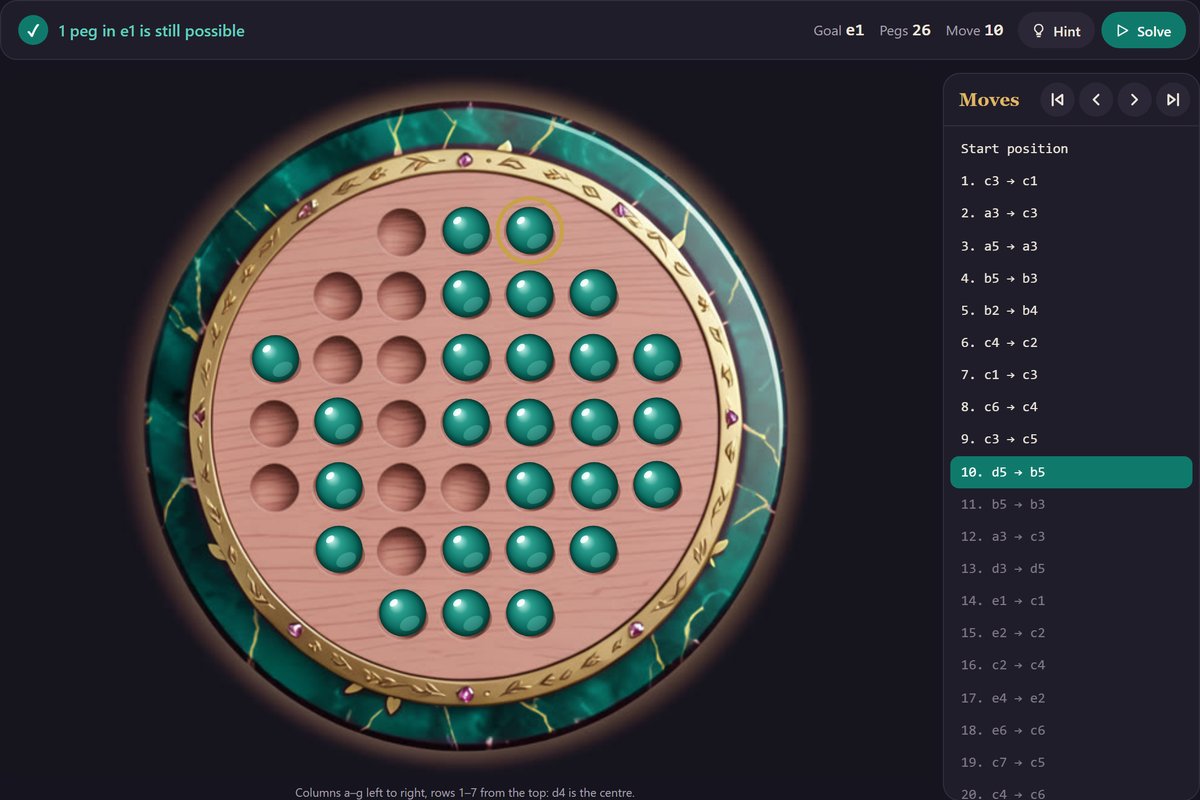 After move 10: 26 pegs
Moves 11 to 20 clear the left arm and the centre.
| Move |
Jump |
Removes |
| 11 |
b5→b3 |
b4 |
| 12 |
a3→c3 |
b3 |
| 13 |
d3→d5 |
d4 |
| 14 |
e1→c1 |
d1 |
| 15 |
e2→c2 |
d2 |
| 16 |
c2→c4 |
c3 |
| 17 |
e4→e2 |
e3 |
| 18 |
e6→c6 |
d6 |
| 19 |
c7→c5 |
c6 |
| 20 |
c4→c6 |
c5 |
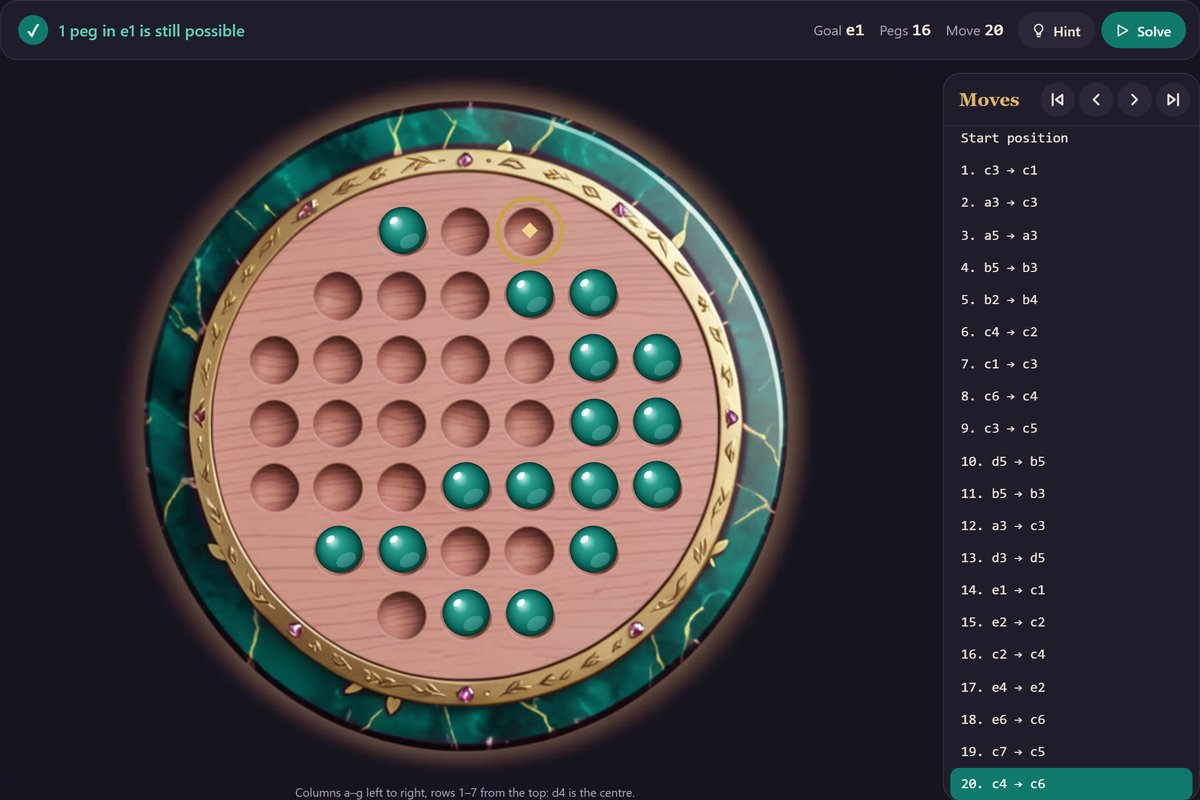 After move 20: 16 pegs
Moves 21 to 30 clear the right arm and the bottom.
| Move |
Jump |
Removes |
| 21 |
b6→d6 |
c6 |
| 22 |
f2→d2 |
e2 |
| 23 |
g3→e3 |
f3 |
| 24 |
g4→e4 |
f4 |
| 25 |
e4→e6 |
e5 |
| 26 |
e7→e5 |
e6 |
| 27 |
f6→f4 |
f5 |
| 28 |
d5→f5 |
e5 |
| 29 |
d7→d5 |
d6 |
| 30 |
g5→e5 |
f5 |
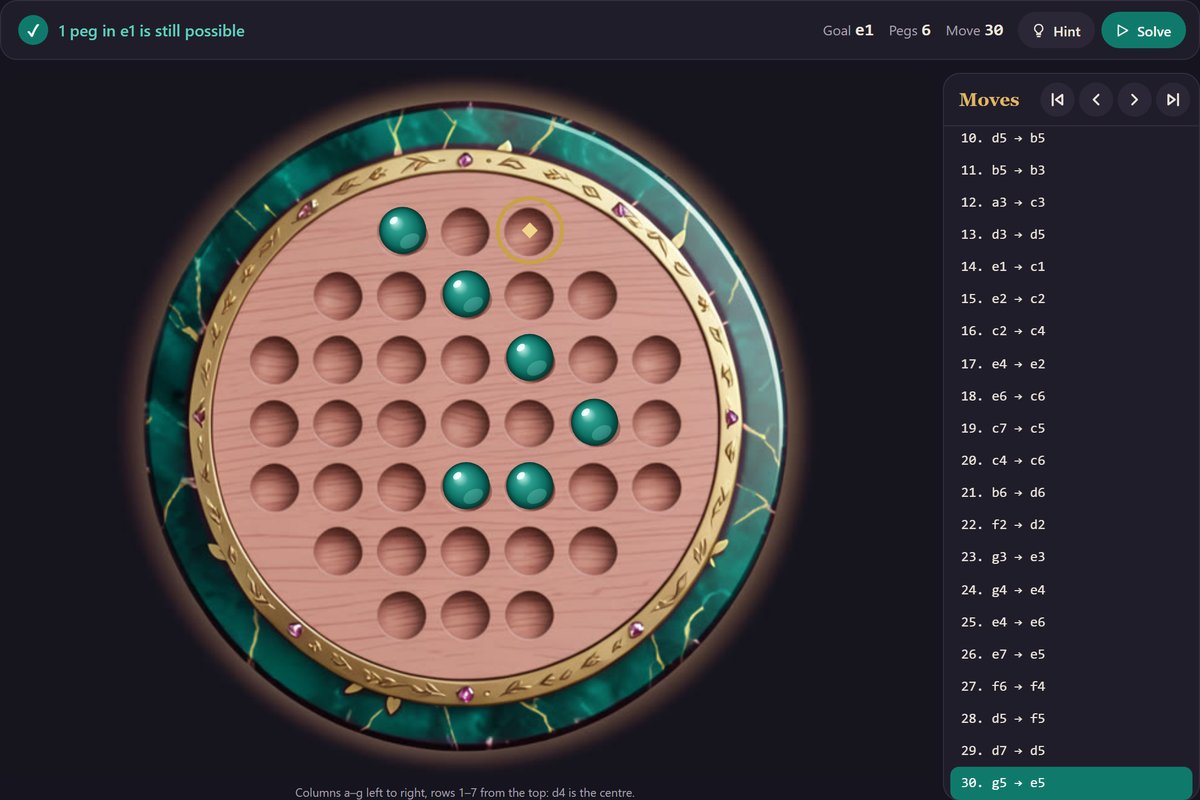 After move 30: 6 pegs
The last five moves bring the pegs together and finish on e1.
| Move |
Jump |
Removes |
| 31 |
d5→f5 |
e5 |
| 32 |
f5→f3 |
f4 |
| 33 |
f3→d3 |
e3 |
| 34 |
d3→d1 |
d2 |
| 35 |
c1→e1 |
d1 |
To watch it move by move, choose c1 as the start and e1 as the finish in our game, then press Solve.
The reverse trick
Every solution also works backwards. Play the same moves in reverse order, from the last move to the first, and you solve the puzzle with the start and finish swapped. The solution above goes from c1 to e1. Start with e1 empty, play move 35 first and move 1 last, and the last peg ends on c1.
Which starting holes can be solved
Not every starting position can be won. Only a game that starts with one of the 16 ticked holes empty can end with one peg. From a crossed hole, at least two pegs will be left. Durango Bill's computer analysis of this board found the same 16 holes, and so does our solver.
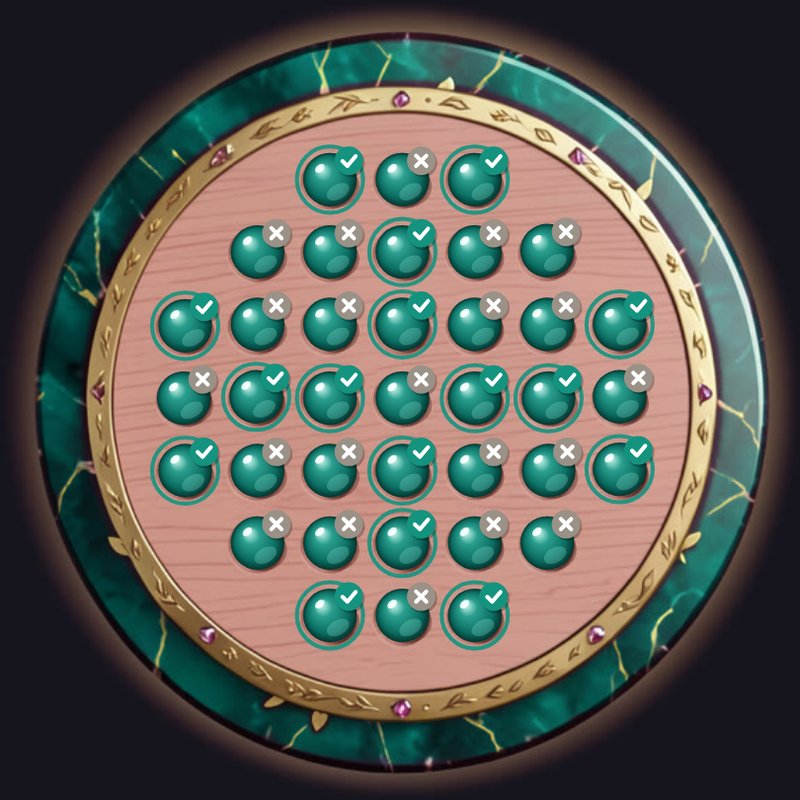
Each solvable start also has exactly four holes where the last peg can finish, and the start hole is never one of them.
| Start with this hole empty |
The last peg can end on |
| c1, c4, f4, c7 |
e1, b4, e4, e7 |
| e1, b4, e4, e7 |
c1, c4, f4, c7 |
| d2, a5, d5, g5 |
a3, d3, g3, d6 |
| a3, d3, g3, d6 |
d2, a5, d5, g5 |
For example, start with c1 empty and you can finish on e1, its mirror hole.
In our game, choose the first peg to remove and the board shows which holes can be solved. To aim for a finishing hole as well, choose both the start and the finish hole.
Why the centre start is impossible
With d4 empty you can't finish with one peg, however you play. The proof is a simple colouring trick from peg solitaire math, which Jaap Scherphuis explains in more detail. Colour the holes in three colours along the diagonals. Every jump changes each colour's peg count by one, so the three counts stay all even or all odd together. They start at 12, 12 and 12, and one peg would need 1, 0 and 0, which mixes odd and even. The same check rules out 21 of the 37 starting holes.
The colouring only says one peg is impossible, not how close you can get. For that, our solver searched every position that can be reached from the centre start, and none has fewer than two pegs, which matches Durango Bill's results. So two pegs is a perfect game from d4. For one peg, start from c1 instead.
French vs English board
This guide and our solver are for the French board: 37 holes and 36 pegs. The English board is 33 hole peg solitaire, with 32 pegs. It lacks b2, f2, b6 and f6, the inner corners of the cross. The rules are the same, but the solutions aren't: moves written for the 32-peg English board never clear the four extra holes, so pegs are left over.
The boards differ most at the centre start. In English peg solitaire you can empty d4 and finish with one peg on d4. On the French board that start can't end with one peg, and neither can 20 other starts.
Marble sets of this board are often sold as 36 marble solitaire, 36 peg solitaire or 37 hole marble solitaire. It's the same game, so if you're looking for a 36 marble solitaire solution, the one above works on a marble set move for move.
Peg solitaire strategy tips
- Start on a ticked hole from the board picture above.
- Pick the finish before the first move.
- Don't leave a peg alone on b2, f2, b6, f6 or at the end of an arm. To get out, it needs a neighbour, either to jump over or to be jumped by, and late in the game there's often none left.
- Clear pegs in groups of three, using one extra peg that jumps out and back.
- When a game goes wrong, go back instead of starting over. In our game, turn hints on to see the moment a game can no longer be won, then click an earlier move in the list and try another jump.
Solve any position
If you're halfway through a game on your own board and can't see a way on, copy the position into our 37 hole peg solitaire solver. Place the pegs as they stand, choose a finish hole if you want one, and press Solve. The whole solution appears in the move list, and you can play it one move at a time with arrows on the board, stepping back whenever you want to see a move again.
History
Peg solitaire comes from France in the late 17th century, when it was a fashion at the court of Louis XIV. The 37-hole French board is the original. The 33-hole English board came later and is now the more common one. A popular story says a prisoner in the Bastille invented the game, but there is no evidence for it.
The first known description in print is from 1697, when the magazine Mercure Galant printed the board, the rules and puzzles with solutions. The same year Claude-Auguste Berey engraved Anne de Rohan-Chabot, Princess of Soubise, beside a 37-hole French board. Leibniz wrote about the game in 1710, and Horace Walpole mentioned it in England in 1746. The Bastille story first appears in an English book of 1801, about a hundred years after the game.
The engraving, Walpole and the Bastille story are from George Bell and John Beasley's paper New problems on old solitaire boards. The Mercure Galant issue is described on Wikipedia, and the Leibniz quote on Rob's Puzzle Page.
More to explore
George Bell has 428 symmetric puzzles for the French board. Each starts from its own pattern of pegs, not a full board with one hole empty, and is solved down to one peg in the centre. Peg solitaire is also played on the 33-hole English board, the 41-hole diamond, Wiegleb's 45-hole board and the 15-hole triangle.